
Advocating for Better Black Maternal Mental Health: Reflections on Trauma, Identity, and Healing with Essie Brown
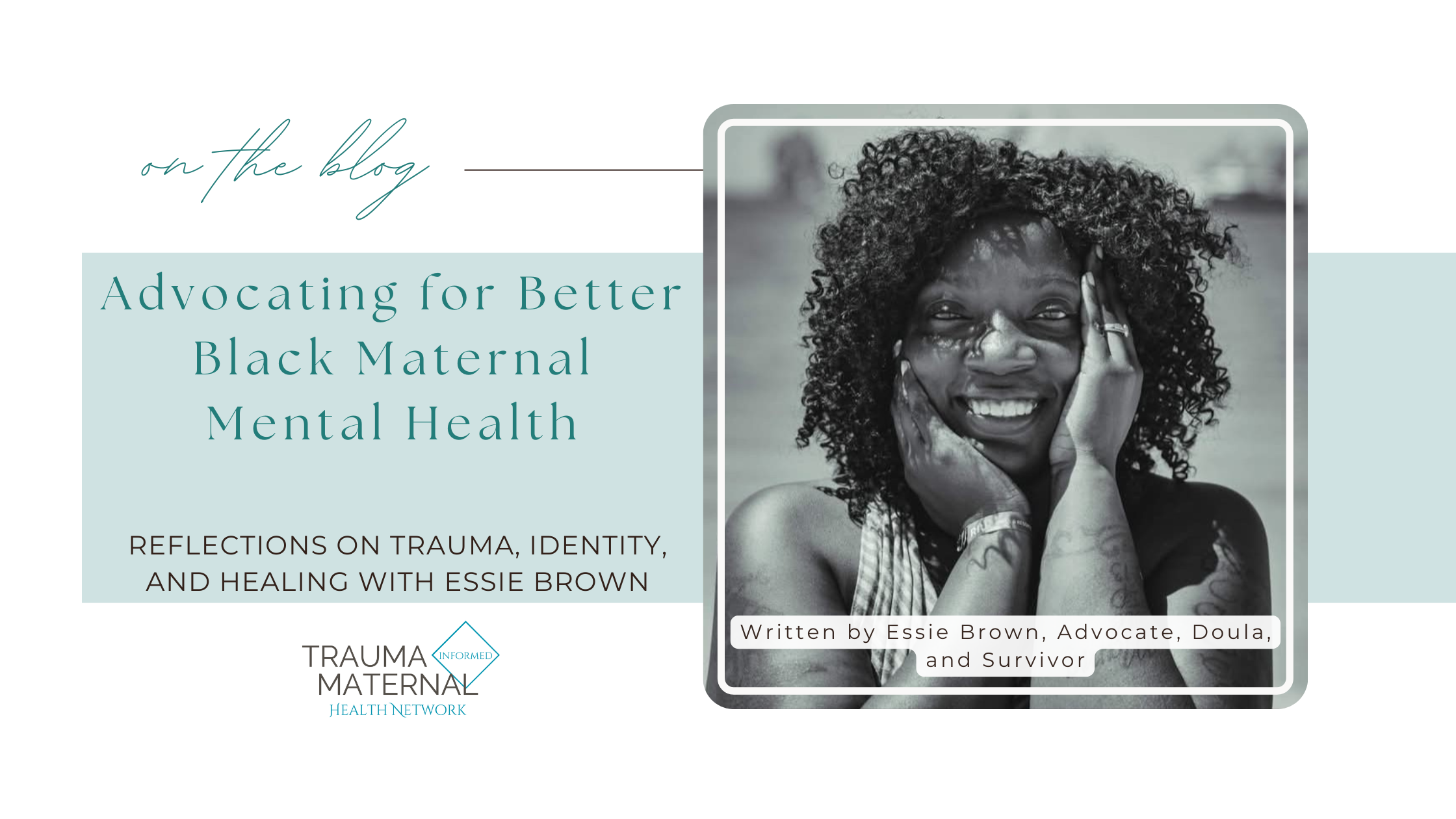
Written by Guest Blogger Essie Brown, Advocate, Doula, and Survivor
Advocating for Better Black Maternal Mental Health: Reflections on Trauma, Identity, and Healing with Essie Brown
For most of her life, Essie Brown didn’t call it trauma. She called it life.
“As a child, I didn’t know or understand what trauma was. I just called it life. But as I got older and saw what life was supposed to be, I started to feel the trauma.”
That shift, from surviving to recognizing, is where her story truly begins.
When Trauma Feels Normal
Essie grew up in an environment where emotional safety simply didn’t exist.
“I wasn’t introduced to any other lifestyle,” she explains. “It was everyday life and felt normal.”
This is how trauma often hides, especially in communities where struggle is common and resilience is expected. When chaos, yelling, stress, or emotional shutdown are everyday experiences, they don’t register as warning signs. They register as routine.
In Essie’s experience, trauma became normalized in another subtle way: humor.
“The community jokes about the trauma often so it feels normalized and real instead of scary and traumatizing.”
When pain is laughed at, minimized, or brushed aside, it becomes harder to recognize the cost. But the body remembers.
Looking back, Essie now sees the signs she couldn’t name at the time. Yelling when overstimulated. Fighting. Isolation. Frequent stomach aches. Dizziness. Stress that never seemed to lift. These were trauma responses, not something wrong with her.
There is something powerful about that realization. It shifts the narrative from “What’s wrong with you?” to “What happened to you?”
Healing Is Not a Destination
Essie’s recommendations for healing are “attending counseling, therapy, and acknowledging your triggers. Knowing who to walk away from and when to walk away. If it all fails, just think it through and remind yourself everything is going to be okay.”
Essie channels her pain into poetry, writing as a way to process what once felt overwhelming. Art became a container when words were hard to find. Her first steps toward healing were surprisingly simple, but deeply radical. She began treating herself the way she wished others would treat her by “taking myself out to eat, to the movies, or shopping.”
This was her way of telling her nervous system: you matter.
Now, her healing is anchored in boundaries. She attends therapy. She protects her progress. She surrounds herself with people who respect how far she has come.
Growth, for Essie, is steady.
The Weight Black Women Carry
As a Black woman, Essie is clear about the added layers trauma carries.
“I feel like they expect Black women to cook, clean, work and take care of our children with little to no help. If we cry or yell, we’re labeled the ‘angry Black woman.’”
This expectation of constant strength has consequences.
When vulnerability is punished or stereotyped, silence becomes survival. Many Black women are conditioned to push through exhaustion, suppress emotion, and carry entire households and communities on their backs.
That conditioning directly impacts maternal mental health.
Black women in the United States face significantly higher rates of maternal mortality and are less likely to have their pain taken seriously in medical settings. In fact, Black women are about three times more likely to die from pregnancy-related causes than white women, with a maternal mortality rate of 55.3 deaths per 100,000 live births in 2020, the highest of any racial group in the country. Emotional distress is often minimized. Trauma is often dismissed.
“I wish more Black women recognized their trauma and spoke up on it. So they can get the help they need. We can all help each other.”
Essie emphasizes the importance of support, whether that is from a therapist, a trusted friend, or a doula. Healing does not have to happen in isolation.
And it should not.
Becoming the Support She Needed
Essie is currently training to become a doula, a role that feels deeply connected to her own journey.
“I don’t want others to go through what I went through, and that alone motivated me to be a doula,” she says. She hopes the women she supports know one thing above all else: “I understand you and I am here for you.”
When asked what matters most when holding space for someone with trauma, her answer is simple and wise: “Always be open to listen. Never be judgmental.”
No fixing. No correcting. No minimizing. Just presence.
In a world that often tells Black women to be strong, silent, and self sufficient, being witnessed without judgment can be revolutionary.
A Gentle Truth
For readers who are just beginning to question whether trauma might be part of their story, Essie offers honesty without shame.
“You probably [or may] have trauma and just haven’t recognized it yet.”
It is not an accusation. It is an invitation to notice the patterns. The triggers. The ways your body reacts before your mind catches up. An invitation to ask harder questions and seek softer spaces.
If there is one thing she hopes readers take from her story, it is this: “I’m a survivor and you are too.” Survival is not weakness. It is proof of resilience.
Essie’s story reminds us that recognizing trauma is not about blaming the past. It is about reclaiming the future. It is about loving yourself enough to seek support. It is about redefining strength, not as silent endurance, but as courageous healing.
Especially in the context of Black maternal mental health, that is advocacy in its most personal form.
From Personal Healing to Maternal Support
Stories like Essie’s are exactly why Maternal Trauma Support exists. Trauma does not disappear when a woman becomes pregnant. It does not pause during postpartum. In many cases, it resurfaces. It amplifies. It demands to be seen. When we create spaces where women can name what happened to them without shame, we interrupt generations of silence. We move from normalization to recognition. From survival to support.
We do not label women as broken; rather, we remind them they are worthy of care, compassion, and competent support at every stage of motherhood. It is about making sure no woman, especially Black women who are so often dismissed or expected to endure quietly, has to navigate pregnancy, birth, or new parenthood alone.
Essie’s story is a call to hold space more intentionally and to build systems of care that honor the full emotional experience of motherhood. Because when one woman recognizes her trauma and chooses healing, she does not just change her own life. She shifts what is possible for the women who come after her.
Resources:
Njoku, A., Evans, M., Nimo-Sefah, L., & Bailey, J. (2023). Listen to the whispers before they become screams: Addressing Black maternal morbidity and mortality in the United States. Healthcare, 11(3), 438. https://doi.org/10.3390/healthcare11030438
- - - - -
Guest Author: Essie Brown, Advocate, Doula, and Survivor
Essie Brown is a maternal mental health advocate, a doula in training, and a survivor dedicated to turning personal pain into powerful advocacy. She is committed to creating spaces where Black women can be seen, heard, and supported through trauma, healing, and motherhood. Through her writing and work, Essie inspires others to recognize their resilience and claim the care they deserve.
About the Trauma-Informed Maternal Health Directory
Liz Gray, LCSW and Olivia Verhulst, LMHC, PMH-C— co-founders of the Trauma-Informed Maternal Health Directory— are clinical psychotherapists with a deep passion for increasing accessibility of trauma-informed care to the maternal health population.
They created this specialized directory to connect women & birthing people to trauma-informed health & mental health providers who specialize in infertility, pregnancy, postpartum, and new parenthood.
Search the directory: https://directory.maternaltraumasupport.com/
Interested in writing a guest blog post?
If you are a trauma-informed provider who works with the perinatal population, submit a blog proposal HERE!
Please make sure the article is original content that aligns with our values of safety, inclusion, transparency, collaboration, empowerment, and support.
Trauma doesn’t suddenly disappear when you become a mother. For survivors of abuse, violence, or other painful experiences, the fourth trimester can activate old wounds in ways that might impact bonding, mental health, and everyday functioning. The good news is that with trauma-informed care and the right support, healing is possible and within reach.